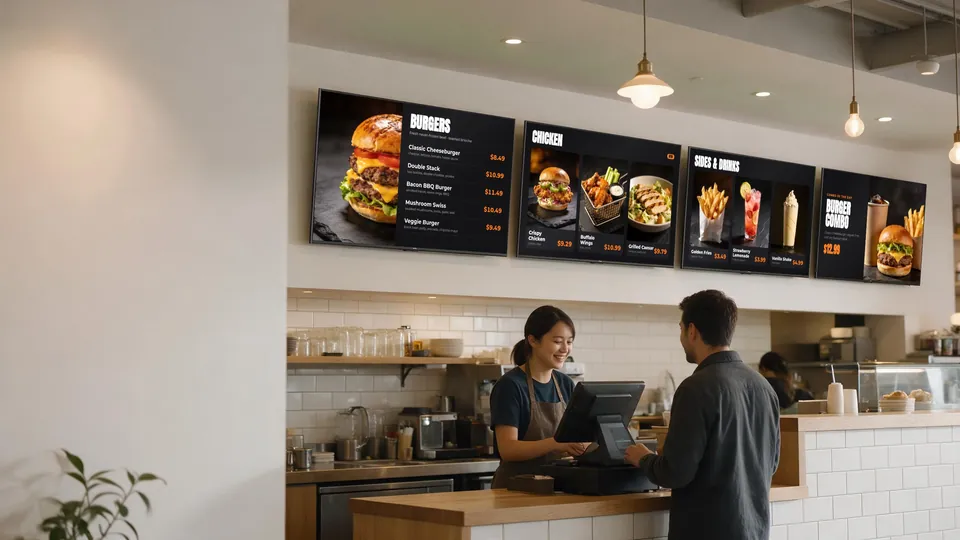
If you're still using printed menu boards or chalkboards, you're likely missing chances to sell. Digital menu boards give you tools that static signage simply doesn't have: motion, great food photography, and the ability to change what customers see by time of day.
How much any single restaurant gains depends on its menu, traffic and how well the boards are used — so instead of quoting a magic number, this guide walks through the mechanisms and the strategies that put them to work.
Where the Extra Sales Come From
Digital menu boards influence sales in a few concrete ways:
- Attention: a moving, bright screen gets looked at more than a faded printed board
- Appetite appeal: high-quality photos of your best items do the selling for you
- Timing: the right items at the right time of day, without anyone flipping a sign
- Accuracy: no selling items you're out of, and no price disputes at the register
Each of these nudges ticket size or order speed a little. Together — and especially when the boards stay in sync with your POS — they add up.
The Psychology Behind Digital Displays
Motion Captures Attention
Human eyes are naturally drawn to movement. It's an evolutionary trait—we're hardwired to notice things that change in our environment. Digital menus leverage this with subtle animations, scrolling content, and rotating featured items.
When a customer walks into your restaurant, their eyes immediately go to the moving display. That means your menu—and your promotions—get noticed every time.
Visual Appeal Stimulates Appetite
High-quality food photography triggers appetite and emotional response in ways that text simply cannot. Digital displays allow you to show full-color, high-resolution images of your dishes. When customers see a juicy burger or a frothy latte, they don't just read about it—they crave it.
Static menus, especially text-heavy ones, require customers to imagine what dishes look like. Digital menus show them, triggering an immediate desire to order.
Dynamic Pricing Enables Strategic Promotion
With printed menus, promoting a high-margin item means reprinting everything. With digital menus, you can spotlight different items throughout the day. Feature coffee in the morning, lunch combos at noon, and appetizers during happy hour—all automatically.
This flexibility lets you promote whatever drives the most profit at any given moment.